Introduction
Ever wondered why you can’t be stopped from practicing your religion, or why the police can’t just detain you without telling you why? That’s fundamental rights India granted its citizens through Part III of the Constitution, and honestly, most people know these exist but couldn’t list more than two or three if asked. In 2026, with digital privacy debates and free speech cases regularly hitting headlines, understanding these rights matters more than ever.
What Are Fundamental Rights?
These are basic rights guaranteed to every citizen (and in some cases, every person) under Articles 12 to 35 of the Constitution. What makes them special is that they’re enforceable — you can go straight to the Supreme Court or High Court if they’re violated.
Quick answer: Fundamental rights India guarantees include equality, freedom, protection against exploitation, freedom of religion, cultural and educational rights, and constitutional remedies — all enforceable directly through courts under Articles 32 and 226.
Right to Equality (Articles 14-18)
This ensures equality before law and prohibits discrimination based on religion, race, caste, sex, or place of birth. Article 17 specifically abolishes untouchability — a rare instance of the Constitution directly addressing a social evil by name.
Right to Freedom (Articles 19-22)
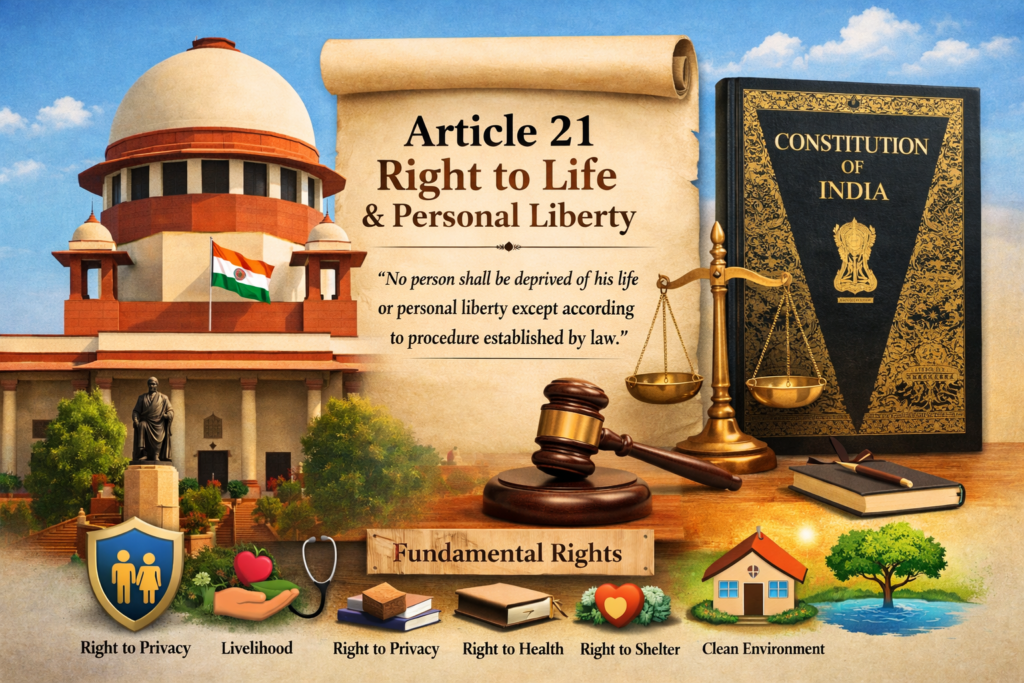
This is probably the most talked-about set of rights. Article 19 covers freedom of speech, assembly, association, movement, and profession — though all with “reasonable restrictions.” Article 21 guarantees life and personal liberty, which courts have interpreted incredibly broadly over the decades (more on that in a separate article on Article 21 itself). [link to related guide about Article 21 here]
I’ve noticed people often think Article 19 gives unrestricted free speech. It doesn’t — restrictions exist for public order, decency, and national security, and that balance is genuinely debated in courts constantly.
Right Against Exploitation (Articles 23-24)
Bans human trafficking, forced labor, and child labor in hazardous jobs (under 14 years). This one doesn’t get discussed enough, honestly, given how relevant it still is in parts of the country.
Right to Freedom of Religion (Articles 25-28)
You’re free to practice, profess, and propagate any religion. The state can’t run religious institutions or force religious instruction in state-funded schools — though this gets tested legally quite often.
Cultural and Educational Rights (Articles 29-30)
Protects minorities’ right to conserve their language, script, and culture, and allows them to establish their own educational institutions.
Right to Constitutional Remedies (Article 32)
Dr. Ambedkar called this the “heart and soul” of the Constitution. It lets you approach the Supreme Court directly if any fundamental right is violated — no need to exhaust other remedies first.
Quick answer: Article 32 allows citizens to move the Supreme Court directly for enforcement of fundamental rights through writs like habeas corpus, mandamus, and certiorari, making it one of the most powerful constitutional tools available to individuals.
Are These Rights Absolute?
No, and this trips people up a lot. Every fundamental right comes with “reasonable restrictions” that the state can impose for things like public order, security, morality, or sovereignty. Picture someone posting inflammatory content online and claiming Article 19 protection — courts routinely balance free speech against public order concerns in such cases.
How Fundamental Rights Differ From Legal Rights
Fundamental rights are constitutionally guaranteed and can’t be taken away by ordinary legislation (only through constitutional amendment, and even then, subject to the basic structure doctrine). Legal rights, on the other hand, come from regular statutes and can be changed more easily by Parliament.
FAQs
Q1. How many fundamental rights are there in India? Currently six categories, after the Right to Property was removed as a fundamental right in 1978 and made a legal right instead.
Q2. Can fundamental rights be suspended? Yes, during a National Emergency, most fundamental rights (except Articles 20 and 21) can be suspended.
Q3. Are fundamental rights available to foreigners? Some, like Article 21, apply to all persons; others, like Article 19, are available only to citizens.
Q4. What is the difference between fundamental rights and directive principles? Fundamental rights are enforceable in court; Directive Principles are guidelines for governance and aren’t directly enforceable.
Q5. Which article deals with the right to education? Article 21A, inserted through the 86th Amendment, makes free and compulsory education a fundamental right for children aged 6-14.
Conclusion
Fundamental rights aren’t just textbook material — they’re the actual legal backbone protecting you from arbitrary state action every single day. Whether it’s speech, equality, or personal liberty, knowing these rights means knowing when they’ve been violated. If you think your rights have been infringed, don’t just complain about it — consult a constitutional lawyer and understand your remedies under Article 32 or 226.
Suggested Alt Text for Images:
- “Fundamental rights India chart Articles 14 to 32”
- “Indian Constitution book with fundamental rights highlighted”
- “Supreme Court of India building representing constitutional remedies”